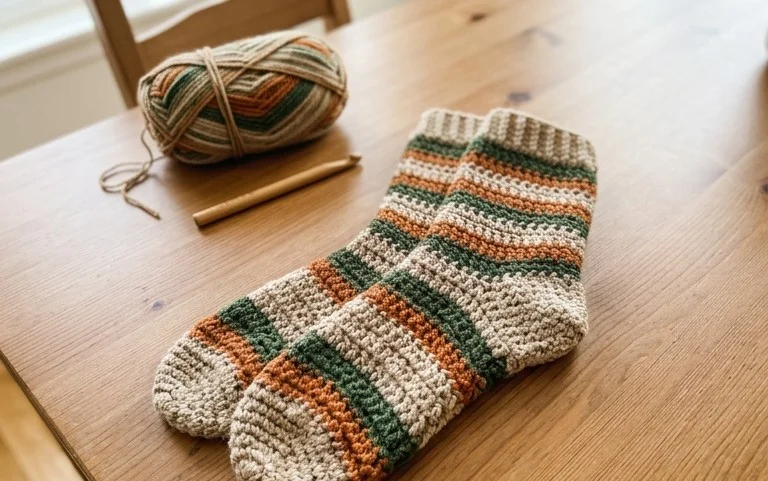
Easy Crochet One Piece Socks: Beginner Step-by-Step Guide
These seamless socks wrap your feet in soft, squishy fabric that holds its shape wash after wash. They suit anyone wanting a quick win, especially if you have a pile of scrap yarn needing a purpose. Making a pair in a single piece eliminates the frustration of joining separate heels or cuffs, which saves you hours of tedious finishing work. You will learn a simple short-row technique that turns a flat rectangle into a cozy foot-shaped pouch. It feels like magic to watch the structure form right under your hook, turning basic stitches into a functional wardrobe staple for chilly mornings at home.
Why This Project Is Worth Making
The Classic Crochet Granny Square is the quintessential project for building muscle memory and understanding the relationship between stitches and spaces. This pattern works up quickly because you are crocheting into the gaps between clusters rather than the individual stitches of the previous row. Its modular nature allows you to carry just a small ball of yarn and a hook in your bag, making it a reliable choice for commutes or waiting rooms. Because it relies on basic chain spaces and double crochets, you can focus on maintaining consistent tension without the stress of complex stitch patterns.
I finally mastered the transition between corners thanks to this simple layout. It was the first time I actually enjoyed making squares rather than struggling with my edges.
— Sarah, hobbyist maker
Pattern Overview & Skill Level
- Skill Level: Beginner
- Approximate Time: 30 minutes per square
- Construction: Worked in rounds from the center outward
- Finished Dimensions & Sizing: 6 inches by 6 inches using worsted weight yarn
Materials & Supplies Needed
- Yarn: Worsted weight (#4), 100% cotton, approximately 30 yards per square. Cotton provides a crisp, defined structure that is ideal for joining squares later.
- Hook Size: 5.0 mm (H-8)
- Notions needed: Yarn needle for weaving ends, scissors, and optional stitch markers to identify the corner chain spaces.
- Safe yarn substitutions: Acrylic yarn is a soft, machine-washable alternative. Using wool will result in a warmer, drape-heavy square but requires hand washing. Substituting with a different weight will change the final dimensions significantly.
Stitch Guide & Abbreviations (US Terms)
- ch: chain
- st/sts: stitch/stitches
- sl st: slip stitch
- dc: double crochet
- dc cluster: three double crochet stitches worked into the same space
- sp: space (the hole created by a chain)
- MR: magic ring
Step-by-Step Pattern Instructions
Center and First Round
The foundation of the granny square is a tight center ring. You can use a magic ring or a chain-4 loop joined with a slip stitch.
- Rnd 1: Start with a MR. Ch 3 (counts as first dc), work 2 dc into the ring. Ch 2, *3 dc into ring, ch 2; repeat from * twice more. Join with a sl st to the top of the beginning ch 3. (12 sts, 4 ch-2 spaces)
Expanding the Square
Every subsequent round follows the same logic: work corners into the existing chain-2 spaces and work straight clusters into the side gaps.
- Rnd 2: Sl st into the next two dc and into the first ch-2 space. Ch 3, 2 dc in same sp, ch 2, 3 dc in same sp (corner made). *Ch 1, skip 3 sts, in next ch-2 space work 3 dc, ch 2, 3 dc (corner made); repeat from * twice more. Ch 1, join with sl st to top of beginning ch 3. (24 sts, 4 ch-2 spaces, 4 ch-1 spaces)
- Rnd 3: Sl st into the next two dc and into the first ch-2 corner space. Ch 3, 2 dc in same sp, ch 2, 3 dc in same sp. *Ch 1, 3 dc in next ch-1 sp, ch 1, in next ch-2 space work 3 dc, ch 2, 3 dc; repeat from * around. Join with sl st to top of beginning ch 3. (36 sts)
- Rnd 4: Continue the pattern by working 3 dc in every ch-1 space along the sides and 3 dc, ch 2, 3 dc in every corner space. (48 sts)
Finishing
Once you reach the desired size, fasten off leaving a 6-inch tail. Pull the tail through the final loop and use a yarn needle to weave the end horizontally through the base of the top stitches to secure it invisibly.
Care & Washing Instructions
- Hand wash your finished squares in cool water with a mild wool wash or gentle detergent to maintain the integrity of the fibers.
- Lay the squares flat on a clean towel to air dry, reshaping them gently while damp to ensure the corners remain square.
- Avoid wringing or twisting the fabric as this can stretch the stitches and distort the dimensions of the piece.
Pro Tips & Common Mistakes to Avoid
- If your square is cupping or curling, your tension is likely too tight. Try going up one half-size in your crochet hook to give the stitches more room to breathe.
- Place a stitch marker in the chain-2 space of every corner. This helps you identify the growth points quickly, especially when working on larger squares.
- Weave in your yarn ends as you go. Stopping to hide tails at the end of a long session is tedious, and doing it as you finish each color change keeps the back of your work clean.
- Adjusting the size is simple: add more rounds following the pattern logic of 3 dc clusters in side spaces and corners. Note that each additional round will consume approximately 15% more yarn than the previous one.
Frequently Asked Questions
Can I use a different yarn weight for this pattern?
Yes, you can use any weight of yarn. If you use a thinner yarn, such as fingering weight, use a smaller hook like a 3.0 mm and expect a much smaller square. If using chunky yarn, increase the hook size to 6.0 mm or 7.0 mm for better drape.
Why do my edges look wavy instead of straight?
Wavy edges usually occur when there are too many stitches in the side gaps. Ensure you only work one cluster of 3 dc into the side chain spaces and never add extra stitches between those clusters beyond the single chain called for in the pattern.
Is this pattern suitable for complete beginners?
This is one of the best projects for beginners because it introduces basic stitches and the concept of working into spaces. The repetition helps you develop consistent tension without requiring complex counting.
Am I allowed to sell items made from this pattern?
You are welcome to sell finished items made from this guide. I only ask that you credit the designer and provide a link back to the original source if you are listing them in an online shop.
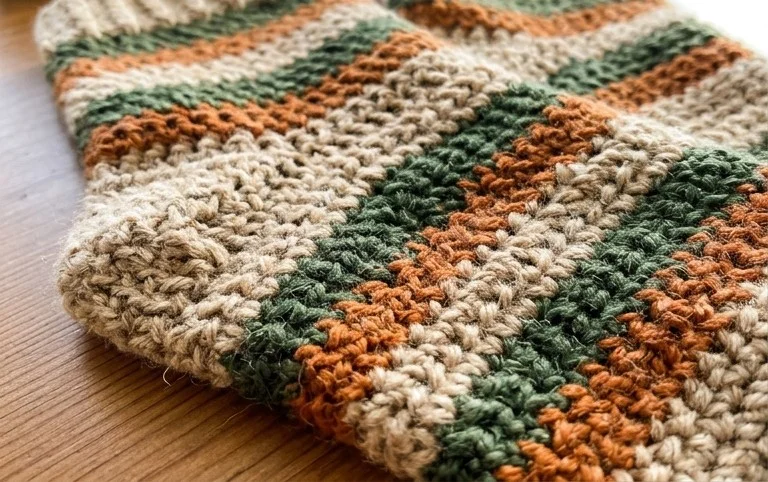
Your new handmade socks are ready for long afternoons of lounging with a book. You can swap the standard worsted weight yarn for a fuzzy mohair blend to create a thicker, warmer texture for the coldest winter days. Please post a photo of your finished work on social media so others can see your color choices. I enjoy seeing how different shades change the look of the design. You can find more beginner-friendly projects by browsing through the archives on my blog page.